

Why I Think Upmarket Will Continue to Dominate the Debut Fiction Market
I recently shared how upmarket deals are dominating debut acquisitions right now, and I wanted to dive more into that today.
But first...I know the term upmarket causes confusion. It’s helpful to remember literary to upmarket to commercial is more of a spectrum than a definitive. A quick primer: upmarket is a marriage of commercial and literary. Agent Carly Watters calls upmarket more character-driven than plot-driven commercial, and more propulsive than slower-paced literary where much of the focus is on language. (However, we do expect to see elevated language in upmarket!)
Technically upmarket is a marketing category, not a genre but we are seeing it being treated more and more as a genre with agents admitting they’re pivoting away from positioning a book as women’s fiction and instead pitching it as upmarket.
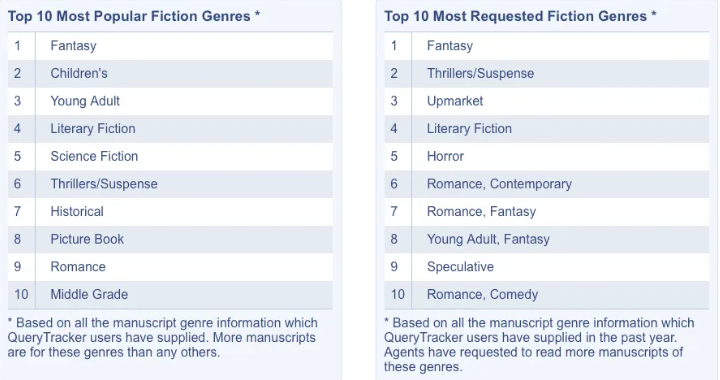
Upmarket accounted for about a third of the debut deals in the first half of this year, and when I did that analysis in July, it was the 4th most requested genre by agents (via QueryTracker) in the preceding 12 months yet it wasn’t even in the top 10 of most frequently submitted.
This week I looked up the data again and upmarket is now the 3rd most requested genre (below right) yet still nary an appearance in the top 10 spots on the most frequently submitted side (below left).
And I don’t think our demand for upmarket is going anywhere anytime soon.
Here’s why…
Upmarket benefits from the social proof of book clubs and reader recs.
Many upmarket books are thought-provoking with hot button issues that drive book club discussions, thereby getting picked for local book clubs as well as the big book clubs like those run by Oprah, Jenna or Reese. This social proof is further magnified when those book club readers recommend them to friends and followers.
Big book club picks are a slam dunk for publisher sales.
Because upmarket books are often selected by those big book clubs, that means big sales. The publishing industry is notorious for publishing many books that never even earn out their author’s advance (let alone pub costs), so an upmarket book’s potential to get picked up by big book clubs gives it an edge over commercial or genre books.
Upmarket often incorporates genre-blending, giving it wider audience appeal.
In recent years we’ve seen more genre-blending in the industry, and while not all genre-blending equates to upmarket, it is a common feature. The Reese’s Book Club May pick, for example, was The Fine Art of Lying, which was categorized by the publisher as both a thriller and women’s fiction. (There’s no BISAC code for upmarket if you were wondering. We usually see it categorized as literary, women’s fiction, or, if applicable, historical fic.)
Upmarket books reflect our current culture and social norms.
Remember what I said about propulsive over slower-paced? It’s not groundbreaking to say our attention spans have decreased by all of our screen use, and it only makes sense that this has impacted our reading: readers no longer have the patience for leisurely reads. We want engaging, page-turning stories. But we still love, beautiful language, and the deeper meaning that we find in the literary market. Upmarket serves all of this.
However, I find many writers don’t even realize they’re writing upmarket. Given the current market and the ongoing confusion, you may just want to check if your story meets upmarket criteria before you pitch it. It might even give you a better shot at landing an agent. (Just please, please don’t call it upmarket if it doesn’t fit!)


Comments